SciComm, Space, Spectacular Scientists

Women in Space: Past

Space is probably my favourite area of science (as you have probably guessed due to the nature of most of my posts), as it involves so many aspects of science: Biology- to assist human space flight and look for life across the universe, Chemistry- to figure out the composition of planets and discover new kinds… Continue reading Women in Space: Past

Astrobiology, Space

What would it be like to live around TRAPPIST-1a?

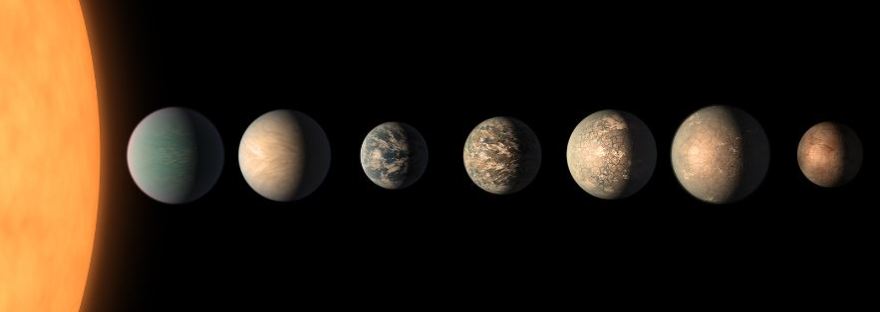
TRAPPIST-1 is a star system about 40 light years away from Earth! The star (TRAPPIST-1a) is an ultra cool red dwarf not much larger than Jupiter, though it is much more massive (as in, has more mass) and was discovered in 1999, but its first exoplanets were only found in 2015 by the TRAPPIST telescope!… Continue reading What would it be like to live around TRAPPIST-1a?

SciComm, Spectacular Scientists

New Scientist Live 2019

'The World's Greatest Science Festival' Early last month, I got to go to New Scientist Live, a 4 day exhibition (though I only went to one day) run by New Scientist, showcasing the talents behind the stories run every week! Tickets are available to everyone, and with 120 talks across 7 stages, and over 150… Continue reading New Scientist Live 2019

Astrobiology, Space

Astrobiology 104: Looking for Life beyond the Habitable Zone

In my last post, I talked about the possibility of life existing within the sunโ€™s habitable zone. Although it is an easy method of elimination when it comes to using precious telescope time, this narrow minded approach is becoming less relevant as we discover more about the conditions in the outer solar system. Read on,… Continue reading Astrobiology 104: Looking for Life beyond the Habitable Zone

Astrobiology, Physics

Astrobiology 103: Looking for life closer to home

In my last post, I talked about how cool exoplanets are, and how we can find them, and look for life there. But there is a small possibility that we wonโ€™t have to travel so far to find life. Although unlikely to be intelligent life, there are some locations that NASA has highlighted, and plans… Continue reading Astrobiology 103: Looking for life closer to home

Astrobiology, Physics

Astrobiology 102: How to find the aliens?

Despite the fact that my last post might have made it seen that chances of finding life are pretty minute, people are still looking! And no, I donโ€™t mean the people who are sure aliens have already visited us (Although if they did manage to find concrete evidence, that would be pretty awesome!) Organisations like… Continue reading Astrobiology 102: How to find the aliens?

Astrobiology, Biology, Physics, Space

Astrobiology 101: Where are all the Aliens?

Terms and Conditions Apply. The Milky Way is over 100,000 light years across. Thatโ€™s a whole lot of football pitches! It has at least 100 billion stars (with some estimates reaching all the way to 400 billion!) and the range in estimates for the number of planets in the galaxy is from โ€˜justโ€™ 50 billion… Continue reading Astrobiology 101: Where are all the Aliens?

Biology

Do plants get sunburnt?

This summer, we have had some extraordinarily hot days, with Europe facing heat waves that broke records! So it is likely that you had to cover up and slather yourself in sun cream- or face getting burntโ€ฆ But I found myself wondering, plants need the sun to survive, so the age-old advice of โ€˜stay in… Continue reading Do plants get sunburnt?

Space, Spaceflight

Moon or Mars?

This past week, there has been quite a lot of attention on space travel, due to the fact that July 20th marked 50 years since the Apollo moon landing! And what makes this even more exciting is that recently, NASA announced its accelerated plans to put people on the moon againโ€ฆ by 2024!ย  The main… Continue reading Moon or Mars?

Particle Physics, SciComm, Space, Spaceflight

Should We Go To Space?

If you were given the chance to go to space, would you? For many, including myself, it would be a truly amazing opportunity. But a question asked more rarely is: Should you? In 2019, the US government gave NASA 21 and a half billion dollars to spend. Sounds like a lot of money. And in… Continue reading Should We Go To Space?